THE ROOT OF BELONGING
Updated: 7 days ago
Belonging is not approval. Belonging is affinity; approval is judgment.
Babies come into the world they belong to without the capacity or need for judgment.
They are not looking for approval. They are looking for connection. Let's call it affinity.
The proof is in our ecological baggage.
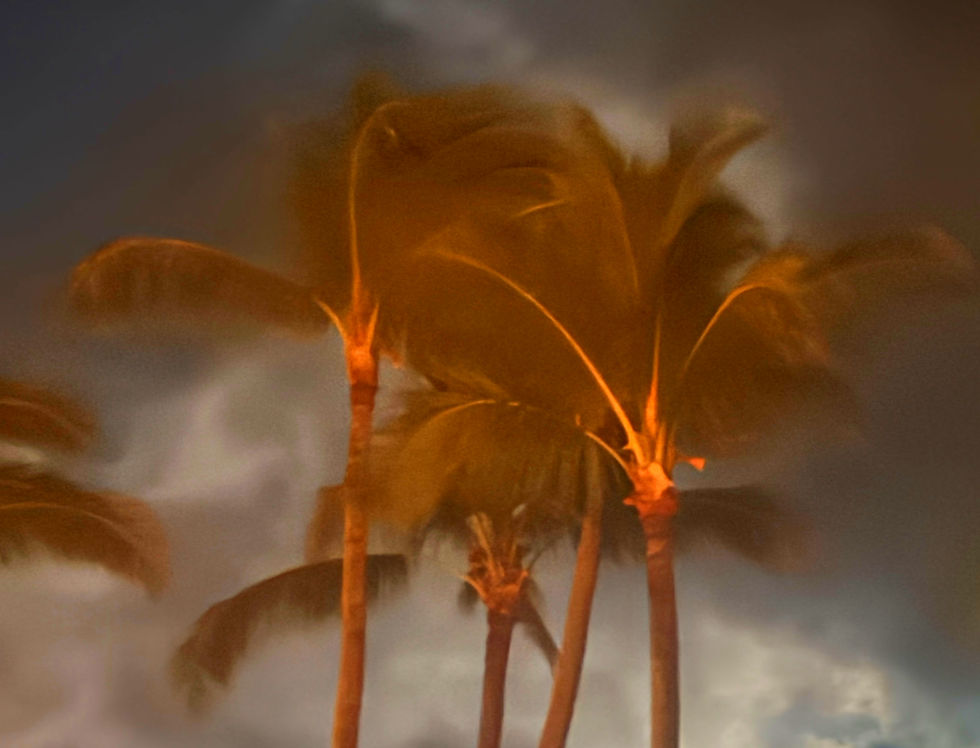
Mother Nature is the master teacher of attraction—not the kind we force, but the kind we learn to trust. Color is how Mother Nature makes us fall in love with life. Like bees with flowers, we are born to belong to this world because its nature lives in us. She uses beauty and color to move us forward with curiosity and attraction.
There is a reason coloring is one of the first creative acts we teach children. Nature comes in colors to teach us that the world we are born into is not only orderly and bountiful, but beautiful.
I grew up in Puerto Rico, riding in the back seat of my father's black Chevrolet Impala with red Naugahyde seats, watching light transform the world through chrome-lined windows. Between sunrise and sunset, I fell in love with color, beauty, and life itself.
Then plans changed, and what I knew changed too.
My childhood commutes stopped when my parents separated. Things didn't seem all that different until the day my dad came to pick me up in another car. I felt a feeling I had never felt before. A profound foreshadowing.
No one told me, but the message was clear: I would never ride in an Impala with red Naugahyde seats again, and my life as I knew it would change forever.
Shortly after my dad sold that car, my mother remarried and tried to transplant me from the smooth, paved cul-de-sacs of the Caribbean to the gravel country roads of Oregon. The contrast was too dramatic to bear.
No matter how beautiful Oregon's vast fir trees and mountain peaks were, I knew there was an aquamarine sky behind its woolly-gray blanket of rain. The beautiful Oregon Coast everyone raved about was a bittersweet reminder of the warm Caribbean shores I used to effortlessly float on for hours.
I couldn't adapt.
For the next seven years, I commuted 3,700 miles each way between contrasting lifestyles, cultures, and climates. Eventually, I no longer felt I was part of either one.
I didn't understand how those commutes would play a role in my life until the summer of 2015, when a car ride and a box of crayons broke a spell and helped me belong again.
I had just been benched from making paint for the next five years. Being cut off from Devine Color—my dream, passion, purpose, and livelihood, the work that had helped me and so many others meet their longing for belonging with a bucket of paint—prompted me to start using color in my meditations.
In one of these meditations, working with guided imagery, I was asked to imagine a beautiful place. I envisioned a deep blue, bowl-shaped lake. I had no idea where that thought came from because my usual place was, drumroll, the shoreline of a Caribbean beach.
Not knowing that Crater Lake, the deepest lake in America, famous for its surreal blue water, happened to be only hours from our home, I Googled deep blue lakes.
There it was.
Neither my husband Scott nor I knew that Crater Lake—the Crater Lake I had heard about—was in our own backyard. I knew something was waiting for us there.
This is the kind of knowing that does not require certainty. It is simply a strong urge, a wonder, a spark of baby-like curiosity that makes you move toward it.
And that's what we did.
We hopped into our midnight-blue BMW convertible and took off on a road trip we named In Search of Blue.
Crater Lake turned out to be an extraterrestrial experience. Its blue water was more unreal than any blue I had ever seen. Even the shores burst with bright lime-green foliage, as if the earth itself had risen to honor its incandescent water.
For the first time in decades, I felt like that child in the back seat of her parents' car, in awe of light, life, and color itself.
We circled the lake's thirty-three-mile rim, contemplating its wonder and wondering how we had not been there before. It was almost as if it rose to the occasion and revealed itself in my mind, inviting me to come visit when I had faced the loss of Devine Color and, with it, the sense of belonging I had worked so hard to create through my color work.
Heading home, we were stopped by road construction. With the top down, we started talking to a road worker who happily answered my endless questions about the lake as we waited.
He explained that Crater Lake is completely self-contained. The water comes directly from snow and rain. No rivers feed it. No rivers leave it. A planet within a planet.
Manna from within.
It was a perfect metaphor for the meditation that had fed me that image.
So naturally, I told him why we had come to Crater Lake, In Search of Blue, and why his words felt so meaningful there, in that light, beside a color on Earth I had never seen before. This was the first time I became aware of my knowing—not as a hunch, gut feeling, or intuition, but as a call from within: a knowing that what I was searching for was already mine.
What I was seeking was seeking me.
Three months later, I was back on the Oregon Coast for an inspire-aspire-aspire-inspire retreat with several women. One of them brought mandalas for us to color as a meditation exercise.
At the time I didn't know Swiss psychiatrist Carl Jung used coloring mandalas as an exercise to reveal hidden parts of ourselves so we could accept them and heal.
For a child, coloring is often their first experience of making something they feel proud of. It quietly builds confidence and ownership, a foreshadowing of what they will need to thrive and survive: the confidence to create beauty of their own.
I had gone from In Search of Blue to color meditations to coloring mandalas in a matter of three months. I drew a mandala called the Tree of Life.
We spread out across a long wooden dining table garlanded with wine, food, and flowers. A box of crayons sat in front of each chair.
Think back to the first time you smelled a crayon. The untouched order of the colors. Peeling the paper back in a perfect curlicue spiral. Breaking one in the middle of a passionate coloring session, promising to be careful, and then breaking another.
I was ready to roll.
I reached for an orange crayon.
Before I knew it, I had turned the entire mandala into a blazing ball of yellow, orange, and rainbow colors.
Once everyone finished, we sat around a fireplace overlooking the Pacific Ocean to share our experience. I laughed and admitted I should have known better: my color choices probably made no sense.
Everyone disagreed.
How is it that everyone knew but me?
They said it looked colorful and bright, like me. They said they could see my culture in it.
Then one woman spoke up.
“Gretchen, the whole thing looks like a juicy mango, ripe and abundant.”
I looked closely.
The color expert in the room didn't see the mangoes on the tree but went ahead and made the entire mandala a mango pie. The tree was filled with fruit. Mangoes, to be exact.
Didn't even see them.
I wondered if I had subconsciously reached for the orange because there were mangoes, or if the mangoes appeared because I went for the orange.
My mango-yellow-orange Puerto Rican roots were beginning to show.
I immediately thought of that car ride, and I blamed Crater Lake.
The woman who pointed out my mangoes was having a revelation of her own. Her mandala was drenched in pink.
Pink was the last color anyone expected from her—think black turtlenecks.
She was wise, intellectual, and assertive. But the more she looked at her pink mandala, the more it became a womb.
Then a dam broke.
Tears poured out as she grieved the loss of the womb she came from when her mother died young. She grieved the daughter she would never have because she could not have children.
She wept for a long time, trying to stop, but her body wouldn't let her until her waters returned to river banks that had bravely contained them for years and no longer could.
As much as we all had met to engage in deep conversations over the last couple of years, these are things we would have never known about her had she not picked up that pink crayon.
I wouldn't have known that orange was part of my cultural color baggage, interconnected and synchronized in extraordinary ways, meaningful to me in a much larger sense. Mangoes happen to symbolize spiritual attainment, which only furthered my resolve to continue with a meditation practice that allowed me to recognize what I know, and share it as knowing.
That summer, a gigantic splash of extraterrestrial blue and a couple of crayon colors showed two women who longed to belong what they could not see.
The loss of belonging was not something to get over. It was something to reclaim—as baggage, birthright, and the bedrock of who we are.
This is what I know.
Coloring is an act of belonging.
Like a honeybee taking a perfectly straight path back to its hive after gathering nectar, we are drawn toward what helps us know where we belong. Color is constantly trying to show us that we are one with Mother Nature.
Belonging isn't about identity. It's about attraction.
When we know together we do better.
Roots
Belong comes from Middle English belongen, “to go along with.” Affinity comes from Latin affinis, “bordering on,” like neighbors. Judgment comes from Latin iudex, “one who speaks the law.”
Who are you drawn to without needing their judgment?
Gretchen.
Author Note
It started with a bucket of paint. Color became my vehicle for self-actualization—not because I loved decorating, but because painting my own walls helped me feel at home. That changed how I felt about myself, my relationship with the world, and what I believed was possible. Color taught me changing a relationship (not people) by clearing the air, knowing together, and doing better can change the world.


Comments